
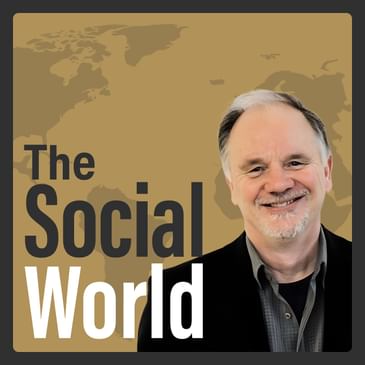


Jonathan Singer , Professor of Social Work at Chicago Loyola University and presenter of The Social Work Podcast for over fifteen years co edits this excellent new publication. Podcasting in Social Work Education.
https://www.amazon.com/Podcasting-Social-Work-Education-Educators/dp/1032215585/
Technology innovations have changed how social work educators teach and students learn. This book is designed to assist social work academics and educators in enhancing their students’ critical thinking, reflective capacity and skills in clinical and research settings through the integration of social work content podcasting.
Written by Mim Fox and Jonathan B. Singer―social work educators, practitioners, and hosts of the award-winning Social Work Stories Podcast and The Social Work Podcast, respectively―this book is an indispensable resource. It is packed with practical tips, insightful advice, compelling case studies, and helpful media links. Essential for all social work educators and practitioners, this book is essential reading for any social worker who is interested in podcasting in social work.
Jonathan B. Singer, PhD, LCSW is an internationally recognized expert in youth suicide and social work technology. He is Professor of Social Work at Loyola University Chicago, Past-President of the American Association of Suicidology, coauthor of two editions of the best-selling text Suicide in Schools: A Practitioner’s Guide to Multi-level Prevention, Assessment, Intervention, and Postvention, co-lead of the Social Work Grand Challenge “Harness Technology for Social Good,” and founder and host of the award-winning Social Work Podcast, for which he was named an NASW Social Work Pioneer in 2023. In 2024 he was inducted as a Fellow of the Society for Social Work and Research.
Dr. Singer has chaired national committees for the National Associate of Social Workers (NASW) and Council on Social Work Education (CSWE) and served on advisory boards for Sandy Hook Promise, Jed Foundation, Suicide Prevention Resource Center, and the 988 Suicide & Crisis Lifeline. He is the author of over 90 publications and his research has been featured in national and international media outlets like NPR, BBC, Fox, Time Magazine, and The Guardian. Dr. Singer is a well-regarded speaker who has presented continuing education workshops, keynote addresses, and presentations on youth suicide, ethics, technology, adolescent development and attachment-based family therapy in the USA, Latin America, Asia, and Europe. In 2024 he was inducted as a Fellow of the Society for Social Work and Research. He lives in Evanston, IL with his wife and three children and can be found on X/Twitter as @socworkpodcast and Facebook at facebook.com/swpodcast.
[00:00:02] Well, welcome back to The Social World Podcast, or if you want to Google it, Thoughts on the Social World. My name is Dave Niven, and as always, it's a pleasure to have your company. Now, we focus a lot on safeguarding and communication. We focus on social work. We focus on caregiving, and we focus on key people in the industry worldwide now.
[00:00:27] Recently, I've been doing a lot, you might have realized, about human trafficking, anti-slavery, etc., and some of the big organized crime drives that people are trying to combat across the globe.
[00:00:41] But also, in the middle of it, it's a way how we talk to each other, those of us that are against these things and want to improve people's lives.
[00:00:49] And I'm so pleased today to have a guest, Professor Jonathan Singer from Chicago, who effectively is one of the most established podcasters in the social work field.
[00:01:02] I think he's been doing it for about 15 years, and he's just published a book with a co-editor, Mim Fox, Podcasting in Social Work Education, A Way Forward for Educators.
[00:01:15] Jonathan, welcome to the program.
[00:01:17] Thank you so much, Dave. It's an honor and a pleasure to be back on the podcast with you.
[00:01:23] Good. Good man. Well, I'm really pleased to get into this now.
[00:01:27] But I think the obvious thing is what people know is, can you just give us a bit of an overview, remembering there'll be different audiences,
[00:01:35] but of the podcasting and social work education publication that you've done, we'll have on the front page all the links,
[00:01:43] how to get this book, how to look at it, how to deal with it, how to investigate what Jonathan was saying.
[00:01:49] But for now, could you just take us into it a bit, Jonathan?
[00:01:53] Absolutely.
[00:01:54] So podcasting and social work education was an idea that Mim Fox brought to me.
[00:02:01] She's a podcaster and a social work professor out of Australia.
[00:02:07] And she has done a remarkable job over the past few years of essentially creating a podcasting production company.
[00:02:21] She she has there are several podcasts that she's involved in social work stories being one of them.
[00:02:28] And she said, you know, lots of folks have been podcasting and lots of folks use it for education.
[00:02:35] There are some folks in social work who are using it for education.
[00:02:38] But but I haven't been able to find anything that really dives down into some of the pedagogical issues,
[00:02:47] some of the things that that educators should be thinking about when they are thinking about either assigning podcasts as learning material or podcasting as an assignment.
[00:03:00] And and this is something that social workers should think about.
[00:03:03] And honestly, when she first brought it up, I was like, well, what is there to think about?
[00:03:09] Like we you know, like, you know, like you, Dave, you've got great episodes.
[00:03:14] You know, if I'm interested in something on trafficking, I might just assign that to my students.
[00:03:18] Right. I don't think much about it.
[00:03:19] But over the course of, you know, two, three years.
[00:03:24] Mim and I really dove into some of the research that that journalists have done on podcasting and radio
[00:03:33] and sort of audio production, the ethics of interviewing people, the ethics of creating and co-creating content.
[00:03:44] Who owns it?
[00:03:46] What does it mean to tell other people's stories?
[00:03:49] And and so the book, it's an edited book because we wanted to get multiple voices.
[00:03:55] So we have folks from Australia, New Zealand, the United States.
[00:04:01] Writing about their experiences with podcasting in various facets of education.
[00:04:08] Remember when you start education, when you started yours, what, 15 years ago, it was a fairly open field.
[00:04:16] Yeah.
[00:04:16] And I think now it's got that feeling of kind of thousands of people in that field, millions, maybe.
[00:04:23] I mean, I think I don't know about half a million, but I mean, it is a real tried and tested means of communication.
[00:04:31] I just think that, you know, you've always been a bit ahead of your time, Jonathan.
[00:04:34] But this is great.
[00:04:35] But it's about time somebody actually classified some of the stuff going on and talked about this communications kind of methodology, if you like, how helpful it is.
[00:04:48] Yeah.
[00:04:49] Yeah.
[00:04:50] And I think there are a couple of ideas that I would love to be able to share with your audience from the book.
[00:04:56] Go ahead.
[00:04:56] Yeah.
[00:04:57] One of them is the idea of when you assign a podcast, when you're listening to a podcast, is it broad casting, right?
[00:05:11] Is it getting information out to a broad swath of the audience?
[00:05:16] Is it an idea that is reaching a lot of people or is it narrow casting, right?
[00:05:22] This idea that you are, in fact, contributing to like an echo chamber, right?
[00:05:28] That I might have a specific perspective, a specific perspective as a professor.
[00:05:36] And I want my students to really understand that perspective.
[00:05:42] And so I might assign a reading and then a podcast that aligns with it.
[00:05:47] And what I'm doing is I'm really hammering home a viewpoint.
[00:05:54] And the question is, how does that fit with my educational philosophy, right?
[00:06:01] How does it fit with my pedagogical stance or my andragogical stance, right?
[00:06:06] If I'm looking to see education as a transformative experience, as an experience where I disrupt ways that my students are thinking about things,
[00:06:20] am I really doing that by assigning two or three materials that essentially say the same thing?
[00:06:28] How am I honoring and acknowledging my students as adult learners who are coming in with their own insights into something if they have no say in what the podcasting content would be, right?
[00:06:46] Because everybody's listening to podcasts these days, right?
[00:06:48] Let me take a couple of points there to develop from what you've just said.
[00:06:52] And on the first hand, whether it's a broad market or a narrow market, you know, that aspect of things, it's something I must admit, I've always kind of wrestled with myself.
[00:07:01] You know, on one hand, I do remember there were some years or some times where I kind of convinced myself that, look, this is there's a niche market here.
[00:07:10] Let's not go get above ourselves.
[00:07:11] You know, we're 10 million listens, you know, you know, I mean, this is for a specific audience, maybe a little broader than social work safeguarding.
[00:07:21] Maybe the law enforcement, health education, that's good.
[00:07:24] But it's a niche market.
[00:07:26] We're not necessarily going to pick up Joe next door.
[00:07:29] Right.
[00:07:30] On the other hand, I think, well, hang about.
[00:07:34] If we're actually walking the walk as much as talking the talk, we should be introducing variations for Joe next door.
[00:07:46] Yeah.
[00:07:47] Things that he or if it's Josephine, you know, whatever she's interested in, in order to engage them in the debate about keeping people safe and caring, you know.
[00:08:00] And so, I mean, I must admit, I've kind of varied between them, just picking up some of these points.
[00:08:06] I just want to tell me what you think about that.
[00:08:10] So I think this is really an important thing that there's a practical side to it.
[00:08:18] And then there's like an intellectual side.
[00:08:22] And I think that you and I probably are very similar in the sense that I'm a professional, right?
[00:08:30] I'm a social work professional.
[00:08:31] And part of being a professional is recognizing your lane, right?
[00:08:36] This is my area of expertise.
[00:08:38] This is what I can speak to.
[00:08:39] And this is what I can't speak to.
[00:08:41] And I think that I have always erred on the side of staying in my lane.
[00:08:52] Now, part of that is kind of technical and kind of production side, right?
[00:08:59] Which is the side that says, I know that things that I'm talking about have broader applicability.
[00:09:05] I just don't have the time or the bandwidth to market it, to find a new audience, to broadcast more widely than what I'm doing.
[00:09:16] And I really think that one of the types of podcasts that would be fantastic if somebody were able to create is what I like to think of as the expert panel podcast, which would be social workers talking about topics that people typically don't think of social workers talking about, right?
[00:09:40] So it's not uncommon to have a TV show or radio show or even a podcast where you'll have somebody with an MBA, somebody with a law degree, somebody who's like an economist.
[00:09:56] And they sit around, they talk about things having to do with everyday life from their perspective.
[00:10:03] Well, social workers have that insight.
[00:10:06] We don't train ourselves to be experts in the same way that lawyers and MBAs do, right?
[00:10:13] But it would be fascinating to have a podcast with social workers who could speak from their expertise on issues that people don't typically think of social workers speaking to.
[00:10:28] Social workers are, of course, because I'm sure that's implicit in what you're thinking as well.
[00:10:32] I mean, social workers are friends, family, neighbours, mums, dads, brothers, sisters, people that live in the real world anyway.
[00:10:42] Yeah.
[00:10:42] And, you know, as well as practising their craft, they're actually living a life.
[00:10:48] That's right.
[00:10:48] And I think as much as anybody, it would be greatly valuable to listen to, as you say, a group of them talking, as long as it wasn't complaining all the time about salaries.
[00:11:01] But, you know, I think, you know, there's always, there would always be room for that, because I'm sure like you have, I've come across some great communicators who don't actually straddle the airwaves very much.
[00:11:20] It's really interesting.
[00:11:21] We're not one of the professions that really you hear commentary from regularly on all the broadcasts or media platforms.
[00:11:30] That's right.
[00:11:31] That's right.
[00:11:32] Yeah.
[00:11:34] So anyway, that was, I think that.
[00:11:36] Sorry, yeah.
[00:11:36] I interrupted you.
[00:11:37] Go on.
[00:11:37] No, no, no, no, no.
[00:11:38] But I think that that's, that's an interesting piece about the, the difference between broadcasting and narrowcasting.
[00:11:44] And it really speaks to the profession that we're in.
[00:11:48] Right.
[00:11:48] I mean, I'll say that, you know, social work's not the only one.
[00:11:51] Right.
[00:11:51] So like, if you think about teachers, you don't typically see a teacher sitting on one of these panels.
[00:11:59] Right.
[00:12:00] And if you did, you would expect them to speak very narrowly to teaching.
[00:12:04] But I mean, teaching is inherently multidisciplinary.
[00:12:08] Right.
[00:12:08] It touches on all facets of life.
[00:12:10] And so why not?
[00:12:11] So I think that there's a way in which these professions get ascribed status.
[00:12:18] And I would love to see social work ascribed a much broader status than it is.
[00:12:26] I couldn't agree more.
[00:12:27] I couldn't agree more.
[00:12:29] I don't know if you ever came across a program I did with a professor from China where he's training social workers to be first responders.
[00:12:39] No, I didn't.
[00:12:40] And that's been going on for about 10 years now.
[00:12:43] And he's based part half in China, half in Hong Kong.
[00:12:47] Well, although they're mostly the same now, but whatever.
[00:12:50] Yeah, yeah.
[00:12:50] But he's actually placed them at great kind of catastrophic events, whether it's earthquakes and tsunamis or great other kind of problematic things that they've gone in at the first wave of responders.
[00:13:05] Because, oh, if you think about all the social work skills, they can make a great difference and kind of support reorganization, bolstering and kind of just general care right after them in the aftermath of a major event.
[00:13:19] I think it's logical.
[00:13:21] And they're actually practicing it now, but we don't do much of that at all elsewhere in the world.
[00:13:26] I just think that kind of innovation is what we should be embracing, you know, things like that.
[00:13:31] Yep, totally agree.
[00:13:34] Anyway, listen, back to your book.
[00:13:39] So are you aiming at educational institutions as much or are you, in your own words, trying to make it broad as well as narrow?
[00:13:49] So this book is specifically directed towards social work educators.
[00:13:56] I think any educator could find value in the book, but we tie in, you know, very social work specific concepts, IFSW, NASW, you know, codes of ethics, things like that.
[00:14:14] And so we talk about it within the context of social work.
[00:14:18] So you could, I mean, I've picked up psychology books that I definitely have applicability, but it's clear that they're written for psychologists because they're talking about things that I don't know anything about related to their organizations.
[00:14:29] But we do have broad concepts.
[00:14:32] Like, so for example, Mim and I developed a framework for social work education and podcasting that we have the very uncreative title called the Fox Singer Framework for Social Work Education and Podcasting.
[00:14:48] And it talks about the components of transformative learning, integrating relationship-based practice, enhancing experiential learning, building a pedagogical blueprint.
[00:15:04] And that one needs a little more explanation.
[00:15:08] It means that podcasts are really integrated with the curriculum, with clear objectives, right?
[00:15:15] In alignment with course outcomes, not just like, oh, here's a reading and here's a podcast, right?
[00:15:22] Like, how does it really fit together?
[00:15:25] And then the last two pieces are leveraging storytelling and lived experiences and then ensuring rigor and relevance.
[00:15:32] And the rigor and relevance has to do with thinking through this issue that I know you and I have thought about,
[00:15:42] and we might've talked about in other interviews, but this idea that one of the strengths of podcasting is that you can get voices that are excluded from academia or big media
[00:16:00] and voices that are really important for folks on the ground because they reflect the lived experience of folks that we work with.
[00:16:11] The downside of that.
[00:16:12] No, but it's so important.
[00:16:14] Sorry, go on.
[00:16:14] Yeah, yeah.
[00:16:15] Yeah, no, no, no.
[00:16:16] It's so important.
[00:16:17] But the reason why we can do that is because the host is the gatekeeper, right?
[00:16:23] And so the downside is the host is the gatekeeper and there is no sense of what is the validity or reliability?
[00:16:32] What's the trustworthiness of the information being shared on a podcast?
[00:16:36] And so having podcasters and having educators think about, well, where does this information land in terms of something that's trustworthy?
[00:16:49] And I gave the example of This American Life, which is a radio show and a podcast that I love.
[00:16:56] Yeah, yeah.
[00:16:56] And in the book, I give an example of how they have had to at least twice retract podcast episodes because they were based on incorrect information.
[00:17:12] Yeah, yeah, yeah.
[00:17:13] And these are huge operations.
[00:17:16] I mean, it doesn't get bigger than This American Life in terms of staff and in terms, you know, and everybody's a journalist, so they have their own codes of ethics there.
[00:17:23] But what would it mean if you interviewed somebody who is talking about trafficking, for example?
[00:17:30] And it turns out that what they were saying was absolutely not true.
[00:17:35] Right?
[00:17:36] Yeah.
[00:17:37] I mean, the whole misinformation sort of validation sort of thing is a huge issue for all major kind of, well, broadcast outlets these days.
[00:17:48] Yeah.
[00:17:49] We're no different.
[00:17:50] But at least what you've just said a minute ago about the host being in control.
[00:17:56] Mm-hmm.
[00:17:56] I mean, a bit like you, I tend to do one-on-ones.
[00:18:01] Yeah.
[00:18:02] Yep.
[00:18:02] And you usually get a sense of kind of with conversation or knowledge of them beforehand, you know, exactly which way they're going to go.
[00:18:12] And I think our antennae are still pretty good, although I've got to say, and I know you did an AI interview yourself, didn't you?
[00:18:20] Yeah.
[00:18:21] But I've got to say that the world is changing quite a bit in terms of misinformation and in terms of the ability to mask misinformation.
[00:18:30] Mm-hmm.
[00:18:31] So, yeah, I mean, I do a lot of things to do with poetry in my sort of downtime.
[00:18:38] And beginning, I judge some competitions and so on.
[00:18:42] And we're getting the first few AI poems getting sent in under somebody's heading, somebody's name, you know?
[00:18:50] Yeah.
[00:18:50] It's all getting to creep in in all sorts of different ways.
[00:18:53] But can I, sorry, I'm doing a bit of talk, too much talking to you.
[00:18:56] But listen, let me ask you the question, because I wanted to pick up what you were saying about the different audiences.
[00:19:01] Mm-hmm.
[00:19:03] I also believe that, yes, you can have an academic professional audience, you will, but at the same time, you've got to be the replacement, I think, for the newsletter.
[00:19:14] You're the replacement for the email round.
[00:19:17] You're the replacement for the, to be honest, sometimes the telephone, you know?
[00:19:21] Well, you're the news giver in many respects.
[00:19:24] And that can really be developed in caring organizations in terms of keep, I mean, I chair a diocese, Church of England, you know, the safeguarding board.
[00:19:37] And one of the dioceses has 500 churches in it.
[00:19:41] Mm-hmm.
[00:19:41] And they communicate by dashboards or by newsletters or words of mouth.
[00:19:49] And that's okay.
[00:19:50] But, I mean, we can all see the benefit of having a regular podcast once a week with key people giving messages and using it as a training platform as well as everything else that's being offered.
[00:20:05] And I think that would apply, I would imagine.
[00:20:07] Tell me what you think.
[00:20:08] But that would apply in many institutions.
[00:20:11] Oh, absolutely.
[00:20:13] Well, and actually one of the early types of podcasting in education was the weekly podcast from the professor to the students.
[00:20:26] Right.
[00:20:26] You had the professor either talking about some of the readings for that week or talking about, you know, something that might not necessarily be assigned for the students but is relevant and interesting.
[00:20:44] Some of the podcasts that were also talking about some of the students.
[00:20:45] Some of the podcasts that were early on talked through some of the issues of the week that were happening in anticipation of the next class.
[00:20:52] And so I think that there is a long history of podcasts being used as a way to convey that kind of information.
[00:21:03] And certainly if you have, you know, some of the people would understand that more.
[00:21:07] How helpful it can be.
[00:21:10] Yeah.
[00:21:11] Yeah.
[00:21:11] Well, now you mentioned AI.
[00:21:14] Yes.
[00:21:14] I hope you don't mind me jumping into this.
[00:21:17] But so one of the things that I wrote back in 2023, right?
[00:21:25] So right now it's December of 2024 and the book came out in November of 2024.
[00:21:32] Back in 2023, I wrote a section where I imagined a future where social work educators could call on AI to automatically generate a podcast on any topic.
[00:21:52] And I write about in the book, you know, imagine that you're you are talking with your students about the concept of empathy.
[00:22:00] And we know that Carl Rogers, who developed person centered therapy and you know, every time I think of Carl Rogers, I just think of somebody grunting in a big armchair.
[00:22:16] That's that is a very funny image.
[00:22:18] Which so so so Carl Rogers, you know, with his reflective listening and things like that.
[00:22:26] And then you have Heinz Kohut, who developed self psychology.
[00:22:31] And and they had different understandings of what empathy was and different understanding of what empathy's role is in in a therapeutic context.
[00:22:43] And so the example I give in the book is, will it be really interesting to be able to ask?
[00:22:50] And I called it SW podcast dot AI.
[00:22:54] Right.
[00:22:55] My pretend AI social work podcasting bot.
[00:22:59] You know, I said, you know, imagine that you could ask SW podcast dot AI to create a 15 minute, 15 or 20 minute podcast episode where it pulls in the voices of Heinz Kohut and Carl Rogers.
[00:23:20] And they have a conversation back and forth about their different understandings of what empathy is.
[00:23:32] And in the book, right?
[00:23:34] You know, when I was writing that, I was like, I really think that this is a possibility.
[00:23:38] I think someday this will happen.
[00:23:39] Well, before the book even came out in September of 2024, Notebook LM, which is a Google product, introduced an audio guide, which is essentially a two person AI generated podcast.
[00:23:56] And, and I think it's phenomenal.
[00:24:24] And it would be a way of creating audio content that is tailored to the audience without requiring humans to have microphones or editing equipment or, or good bandwidth for their internet or time or whatever it is.
[00:24:47] Right.
[00:24:47] It's, it's, it's, it's truly a remarkable era that we are entering into.
[00:24:52] I think our imaginations are being really stimulated by the possibilities of AI.
[00:24:59] This is all on the upside.
[00:25:01] Yeah.
[00:25:02] I do.
[00:25:03] And I think there's plenty of opportunity to harness AI to our needs.
[00:25:10] I think there'll always be though on the downside people and things that will be, will be scared about.
[00:25:18] Sure.
[00:25:19] And, and I think the transmission of information in itself is not necessarily scary, but if it takes me back to a couple of points you made before about misinformation, all it needs is for AI to pick up misinformation, albeit unintendedly maybe.
[00:25:36] Yep.
[00:25:36] And suddenly it becomes gospel.
[00:25:40] Mm-hmm.
[00:25:41] And I, and therefore, but there's no human to correct.
[00:25:47] And it's, I just, I don't know.
[00:25:49] I just think you're absolutely right.
[00:25:51] I think we are going to have to embrace AI in all sorts of forms and guises and hosting podcasts and making up conversations between key people from the past.
[00:26:04] That sounds brilliant.
[00:26:06] I, I, I just, I, I suppose I'm just being a little bit skeptic and now that I've hit 21, I'm also a little bit cynical.
[00:26:17] Well, I, I love, I think, so I think that social workers have an ethical obligation to be skeptical and an ethical obligation not to shut the door.
[00:26:30] Yeah.
[00:27:00] Um, uh, to be targeted rightly or wrongly, uh, by the state, you know, all sorts of things.
[00:27:07] And so I think both of those are important.
[00:27:09] Okay.
[00:27:10] Look, maybe, maybe the last sort of few minutes or so, but, um, can you just flood the airwaves a little bit with some kind of more key things, perhaps from the book?
[00:27:23] So that people get an even broader picture, because I'm really hoping that they're going to go looking for this.
[00:27:29] Um, so, you know, some of the other things that you might've considered in the book that you might've left hanging as kind of, um, questions in the air, as it were for educators.
[00:27:41] Yeah.
[00:27:42] Yeah.
[00:27:42] Um, so one of the big questions really has to do with the ethics of, um, uh, creation or co-creation, co-construction of podcast content.
[00:27:56] So I'm going to use this, what we're doing right now as an example.
[00:28:00] So, uh, uh, I mean, we've known each other for years.
[00:28:03] Um, and, and we have a, we have a, uh, a good relationship.
[00:28:08] I trust you.
[00:28:09] You trust me.
[00:28:10] Um, you've asked me questions.
[00:28:12] I've answered them.
[00:28:13] And at some point you're going to send me an email and you're going to say, I've published the episode.
[00:28:20] So there's a lot of trust in there because if you have the skill, you could edit the podcast to make it sound like I'm saying something I didn't say.
[00:28:31] Now we know that you and I don't have that skill, nor do we have the time or interest to make up, make, make our guests say something they don't say.
[00:28:40] But, um, if you're working with, uh, um, if you're working with a community that has traditionally been, um, silenced or misrepresented, um, and you hear somebody on an interview say something that you know is going to create a firestorm in your listening community or controversial.
[00:29:07] Um, the question is, what is your role as the, the producer, the host, the person who really has kind of a reputation on the line, um, in the context of getting out a message or a perspective or an energy maybe, um, that, uh, that has value.
[00:29:29] Do you have an ethical responsibility to, to do that?
[00:29:33] Right.
[00:29:34] Um, and, and I think this is really hard.
[00:29:38] It's, it's one thing to say, here's a piece of, of written material, you know, edit it.
[00:29:43] But once something has been, um, uh, audio recorded, it's really hard to, to edit that together.
[00:29:53] No, I totally get what you're saying.
[00:29:57] I, I, I, I don't know the exact answer, but I, I, I really appreciate the challenge.
[00:30:02] If you see what I mean, uh, yeah, people like us will have, I mean, in validating what we hear and in, in putting it out.
[00:30:10] And let's, let's wrap it up a bit at that, because I think the ending ending is, is kind of this uncertain future, but I do think it's a marvelous tool.
[00:30:19] And I think you've managed to capture all the good possibilities as well as the challenges in your book.
[00:30:27] I mean, I, I might, you know, we might try and get ahold of Mim and get her on with you for a follow-up.
[00:30:33] I think that might be a good thing to do.
[00:30:34] And if you're going to develop some more thinking about, um, panel issue or a collection of podcasts, I don't know, what, what's the noun for a collection of podcasts?
[00:30:45] I wonder, anyway, um, that, that would be a very, I think that would be fascinating.
[00:30:52] And I'd love to do it with you, Jonathan.
[00:30:54] But listen, in the meantime, can we just say thanks ever so much people buys book.
[00:30:59] It's worth it.
[00:31:01] And, um, I'll pick it up with you very soon.
[00:31:04] And maybe we have you and Mim on, if that would be a good thing to do.
[00:31:07] And we have a sort of a, a three-way kind of dissection of how it's been after another couple of months or so.
[00:31:14] That'd be wonderful.
[00:31:15] I would love that, Dave.
[00:31:17] Yeah, that'd be great.
[00:31:18] Thank you so much for inviting me on to talk about this, uh, uh, this slightly esoteric topic of, of podcasting and education.
[00:31:27] I know, but we've got to start somewhere.
[00:31:28] It's like, you know, there's some lovely clouds before the rain.
[00:31:33] All right.
[00:31:34] I will, um, I will stop the recording now by just saying thanks ever so much, Professor Jonathan Singer.
[00:31:41] Cheerio.
[00:31:41] Thanks, Dave.
[00:31:42] Thank you.